Dubrovnik Airport (DBV, Čilipi) sits about 30 minutes south of Dubrovnik, which makes it the most common starting point for guests heading directly into Montenegro. Of all the airport-to-Montenegro runs we handle at Dubrovnik Limo, the Budva drop-off is the most-booked. People land in Čilipi, want to skip the city centre, and just need to get to their Budva hotel in time for dinner.
This is the practical guide we’d give a guest before they book — actual route, real options, and where each option breaks down.
Quick facts: Dubrovnik Airport to Budva
- Driving distance: ~93 km via the coastal Adriatic Highway
- Drive time off-peak: 2 h to 2 h 15 min including border
- Drive time peak summer: 3 h+ if border or Bay of Kotor traffic backs up
- Border crossings: Karasovići – Debeli Brijeg (main, busy) or Vitaljina – Kobila (smaller, often faster, slightly longer route)
- Bay of Kotor shortcut: Kamenari–Lepetane car ferry, €4.50 per car, 10 min crossing, every 15–30 min
- Documents: Passport strongly recommended; entry rules depend on nationality, so check current rules before travel
- Currency in Montenegro: Euro (same as Croatia)
The route in plain English
From Dubrovnik Airport you drive south on the Adriatic Highway (D8) past Cavtat, cross the Croatia–Montenegro border, continue along the coast through Igalo and Herceg Novi, take the Kamenari–Lepetane car ferry across the Bay of Kotor (or drive around if the ferry queue is long), pass Tivat, and arrive in Budva.
The whole drive is on the coastal road — there is no highway shortcut on the Montenegrin side until you get inland past Budva. Most of the drive time depends on three things: which border you take, whether the ferry queue is moving, and what time of year you’re travelling.
Which border crossing makes sense
There are two practical options when driving from Dubrovnik Airport into Montenegro:
Karasovići – Debeli Brijeg. The main coastal crossing, directly on the Adriatic Highway. Open 24/7, handles all traffic including buses and trucks. This is the default — most buses and most rental cars come through here. The downside is summer traffic. From late June through August, especially weekends, this border can back up for 1–3 hours in the afternoon. Most signs of the queue are not visible from the highway until you’re already in it.
Vitaljina – Kobila. A smaller crossing closer to the sea, about 8 km south of the main one. Generally open around the clock and used by passenger cars and motorcycles — buses and trucks go through Karasovići. The route detour adds maybe 10–15 minutes of driving compared to going straight through Karasovići, but in peak summer the queue here is often half (or less) of the main border.
Our chauffeurs check live border camera feeds before each Dubrovnik-to-Montenegro transfer. If Karasovići looks heavy, they’ll route the guest through Vitaljina instead. The detour is worth the swap when the main border is over 30 minutes deep — both options are within 5 km of each other on the Croatian side, so we can decide based on what we see that morning.
Transport options compared
There are five realistic ways to get from Dubrovnik Airport to Budva. From the private transfer side, we see where each option breaks down for guests with luggage, kids and a hotel check-in window.
Private transfer (door-to-door)
This is the option that fits most arrivals — luggage, families, late-night flights, or an early check-in time. A pre-booked airport transfer driver waits in the arrivals hall with a name sign, helps with bags, and drives directly to the Budva hotel address.
What you get: fixed price agreed before the trip, no meter, free waiting if your flight is delayed (we track flight numbers), child seats on request, and a driver who picks the border based on live conditions. If you have an apartment booking in old town Budva where cars cannot go all the way in, the driver will get you to the closest legal drop-off point.
Best for: families with kids, groups of 3+, late or early flights, anyone who doesn’t want to manage Montenegrin border logistics on their own. Full pricing and routing on our Dubrovnik to Budva private transfer service.
Rental car
Hertz, Avis, Sixt, Europcar and a handful of local agencies have desks in the Dubrovnik Airport arrivals area. Renting a car makes sense if you want a vehicle for your full Montenegro stay and plan to do day trips on your own.
What to know:
- Cross-border permission: Tell the rental company you’ll be driving into Montenegro. Most charge a cross-border fee per day, and some require advance notice — confirm at the desk before signing.
- Green Card insurance: Some companies include Montenegro coverage; others charge extra. Check the rental papers before leaving the desk.
- Drop-off in Montenegro: Most agencies don’t allow it, or charge a significant one-way fee. If you plan to fly out of Tivat or Podgorica, factor this in before booking.
- Parking in Budva: Old town is car-free. Public garages and lots charge an hourly or daily rate that goes up in peak season.
For a one-way airport-to-Budva drop-off without a need for a car after, the rental usually doesn’t pencil out — between the daily rate, fuel, cross-border fee, and Budva parking, it often ends up costing more than a private transfer for two or three people.
Bus (with transfer in Dubrovnik)
There is no direct bus from Dubrovnik Airport to Budva. To take a bus, you first need to get from the airport to Dubrovnik’s main bus station (autobusni kolodvor), then catch an intercity bus to Budva.
- Airport to Dubrovnik bus station: Platanus airport shuttle or local bus 11. About 30–40 minutes.
- Dubrovnik to Budva intercity bus: Bozur, Croatia Bus, FlixBus and a few others run this route. Tickets are typically in the low double-digit euro range, depending on operator and season.
- Frequency: 3–4 daily departures, fewer in winter.
- Total trip time: 4–5 hours including the airport-to-station leg, the wait, and the bus itself with border stops.
Buses cross at Karasovići – Debeli Brijeg (the main border) — they don’t take the smaller Vitaljina crossing. There is a separate bus lane at the border, which sometimes moves faster than car traffic, but with multiple buses queuing in summer it can still take an hour to clear.
Bus is the cheapest option but rarely the smartest if you have luggage, kids, or a hotel check-in window. The transfer in Dubrovnik also adds friction — different platforms, ticket counters, and timing pressure if your flight lands late.
Taxi
Local Dubrovnik taxis can be found at the airport rank. A metered or quoted ride to Budva is technically possible, but in practice it has problems:
- Many Dubrovnik taxi drivers won’t take a Montenegro run — the cross-border insurance (Green Card extension) needs to be in order, and not every car has it.
- Those that do often quote a flat rate on the spot, which can vary a lot between drivers and seasons.
- You’re committing on arrival without a price agreed in advance.
For the same fixed price (or often less), a pre-booked private transfer is more predictable.
Dubrovnik to Budva ferry
A seasonal fast catamaran runs from Dubrovnik to Budva in summer. The crossing is about 2 hours one way, foot passengers only — no cars. Tickets are sold per person and prices vary by season.
For airport pickups this isn’t usually a clean option, because the ferry leaves from Dubrovnik Old Port (not the airport), so you still need a transfer or taxi from Čilipi to the port first. But if your flight lands in the morning and you’re travelling light, the ferry can be faster than driving on a peak August day when both borders are jammed.
Schedule: typically two daily crossings in July and August, fewer elsewhere in the season, and no service in winter. Always check the operator’s site (currently sold via ferryhopper.com and similar) close to your travel date.
The Bay of Kotor — drive around or take the ferry
About halfway through the drive, after Igalo and Herceg Novi, you reach Kamenari and a decision: take the Kamenari–Lepetane car ferry across the Verige strait (10 minutes, €4.50 per car), or drive the long way around the bay through Kotor, Perast and Risan.
When the ferry makes sense
The ferry shaves about 30 km and 40–45 minutes off the drive. It runs frequently in peak season — usually every 15–30 minutes — and less often off-season, but the line operates around the clock. If your goal is to get to Budva quickly, the ferry is almost always the right call.
Pay in cash or by card at the kiosk on the Kamenari side, drive on, and you’re in Tivat 10 minutes later. From Lepetane to Budva is another 25 km of coastal road — about 30 minutes if traffic is normal.
When to drive around the bay instead
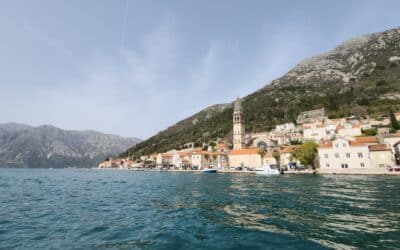
The drive around the Bay of Kotor passes Perast (with its two famous islets) and Kotor old town — both UNESCO-listed and worth seeing. If your transfer doubles as a sightseeing drive, this is the way. Add 1–2 hours for stops.
The other reason to drive around: ferry queues. In peak July and August Saturday afternoons the queue at Kamenari can stretch 30–60 minutes, sometimes more. At that point the ferry’s 10-minute crossing doesn’t really save time anymore. When the queue is clearly long, the smart move is to keep driving around the bay instead. Many of our guests with extra time turn the day into a half-day around the bay using our Dubrovnik to Kotor private transfer with sightseeing stops.
Border paperwork — what guests forget
Croatia is in the EU and Schengen; Montenegro is not. This is a real international border with passport control on both sides. Entry rules depend on nationality — always check the current rules before travel.
- Passport: Required for everyone in the car, including children. EU national ID cards work for EU citizens, but a passport is safer and required for non-EU travellers.
- Visa-free entry: Most EU, UK, US, Canadian, Australian, and many other passport holders enter Montenegro visa-free for stays up to 90 days. Always confirm based on your nationality.
- Vehicle insurance: Croatian rental cars need a Green Card extension or local Montenegrin insurance, sometimes bought at the border for a small fee. Our private transfer vehicles all carry the extended insurance.
- Currency: Both Croatia and Montenegro use the euro, so no exchange needed.
- Hotel registration in Montenegro: Your accommodation registers you with the police automatically — guests do not need to do anything personally.
The most common mistake we see is guests relying on an ID card, driving licence or residence permit instead of a passport. Some EU citizens may be able to enter Montenegro with a national ID card, but non-EU travellers should carry a passport and check current entry rules before travel. A residence card alone is not a substitute. Always travel with a passport on this route.
When summer traffic gets ugly
The honest truth about this drive in July and August: a 2-hour off-season trip can stretch to 4 hours on a Saturday in mid-August, and most of that delay is at the border or the ferry. A few things that help on this drive in summer:
- Travel before 8 AM or after 7 PM when border queues are shortest.
- Check the live HAK and Vitaljina cameras before leaving — switch borders if needed.
- Skip the Bay of Kotor ferry if Kamenari has a long queue and drive around instead — sometimes faster, always more scenic.
- Avoid peak August weekends if possible — late August in particular tends to bring heavy return traffic, with border queues that can run for hours.
For guests on a tight schedule with a hotel check-in, we factor a 30–60 minute buffer into peak-season departure times. It’s better to arrive early than to miss check-in because the border was worse than expected.
What’s actually in Budva when you arrive

Budva is the most-developed beach resort on the Montenegrin coast, and that cuts both ways. The old town is small but genuinely Venetian — walled, dense with stone houses, and walkable in 30 minutes. The Slovenska Plaža beach strip stretches several kilometres east of the centre with hotels, beach clubs, and a long promenade. Sveti Stefan, the iconic islet hotel, is 6 km south.
For first-timers, two or three days in Budva is enough to see the old town, swim at one of the better beaches (Mogren is closest, Jaz a few kilometres north), and have a couple of dinners. Most of our guests use Budva as a base for day trips — Kotor, Sveti Stefan, Lovćen, or back across the border to Trebinje.
How we help clients with the Dubrovnik Airport to Budva run
This is one of the busiest routes on our schedule. A typical booking: family of 4 lands at Dubrovnik Airport at 14:00, we pick them up in arrivals with a name sign, drive south through the Vitaljina border (skipping the Karasovići queue), take the Kamenari ferry across the bay, and drop them at their Budva hotel by 17:00.
If the route includes a sightseeing stop in Cavtat, Herceg Novi, Perast or Kotor along the way, we plan it as an extended transfer with stops rather than a straight drop-off. Many of our guests turn this into a half-day Bay of Kotor tour with the airport pickup as the start point.
If you’d like us to handle the airport pickup and the drive to Budva, send us your flight details and Budva accommodation address. We’ll work out the timing, pick the right border for the day, and confirm the driver’s WhatsApp number before your trip.
For a fixed-price airport pickup with a driver who knows the border, see our Dubrovnik to Budva private transfer service.
Frequently asked questions
How long does it take to drive from Dubrovnik Airport to Budva?
Off-peak the drive takes 2 hours to 2 hours 15 minutes, including the Croatia–Montenegro border and the Kamenari–Lepetane car ferry across the Bay of Kotor. In peak summer (July and August) plan for 2 hours 45 minutes to 4 hours total, depending on border and ferry queues.
Which border crossing is best from Dubrovnik to Montenegro?
Karasovići – Debeli Brijeg is the main 24/7 crossing on the Adriatic Highway, used by all bus and truck traffic. Vitaljina – Kobila is a smaller crossing 8 km south, open only to passenger cars and motorcycles, often with shorter queues in peak summer. The detour adds 10–15 minutes of driving but can save 30+ minutes at the border. Buses must use Karasovići.
Do I need a passport from Dubrovnik to Budva?
Yes. Montenegro is not in the EU or the Schengen Area, so the Croatia–Montenegro border is a full international crossing. All travellers should carry a valid passport, including children. EU national ID cards are sometimes accepted for EU citizens, but a passport avoids any issue at the border.
Is there a direct bus from Dubrovnik Airport to Budva?
No. There is no direct airport-to-Budva bus. You first need to take a shuttle or local bus from the airport to Dubrovnik’s main bus station, then catch an intercity bus from there. Total trip time is typically 4–5 hours including transfers.
Can a Dubrovnik taxi take me to Budva?
Some can, but many cannot — Croatian taxis need a Green Card insurance extension to enter Montenegro, and not all carry it. Pre-booked private transfers are designed for cross-border runs and have the right paperwork ready. The price is fixed in advance, unlike a taxi quote on arrival.
Should I take the Kamenari–Lepetane ferry or drive around the bay?
Take the ferry if you want to get to Budva quickly — it shaves about 30 km and 40–45 minutes off the drive, costs €4.50 per car, and runs every 15–30 minutes. Drive around the bay if you want to see Perast and Kotor en route, or if the ferry queue is over 30 minutes long in peak summer.
Is there a ferry from Dubrovnik to Budva?
Yes — a seasonal fast catamaran runs from Dubrovnik Old Port to Budva in summer (typically July and August), foot passengers only. The crossing takes about 2 hours and tickets start around €40 per person. There is no car ferry on this route.