Trebinje is the easiest cross-border day trip out of Dubrovnik. Thirty kilometres on a quiet inland road, one small border crossing that’s usually much less crowded than the main Montenegro crossings, and a Bosnian town that feels nothing like the Croatian coast. We drive guests there several times a week from spring through autumn — usually as a half-day before they fly out, or as a wine and monastery day combined with Tvrdoš and a Hercegovina lunch.
This is the practical version of what’s there, why it’s worth the drive, and what we tell guests in the car on the way over.
Quick facts: Dubrovnik to Trebinje
- Distance: 30 km from Dubrovnik old town
- Drive time: 40–50 minutes including the border
- Border crossing: Brgat Gornji (Croatia) – Ivanica (Bosnia and Herzegovina)
- Documents: Passport strongly recommended; entry rules depend on nationality, so check current rules before travel
- Currency: Convertible Mark (BAM); euros sometimes accepted in tourist-facing places, but bring some BAM
- Best for: Half-day or full-day trip with monastery, wine, and old town
The drive from Dubrovnik to Trebinje
Trebinje sits in eastern Hercegovina, just over the mountain ridge from the Adriatic coast. The road climbs out of Dubrovnik through the village of Brgat, crosses the small Brgat Gornji border, and drops down into the Trebišnjica river valley. Most of the drive is two-lane mountain road with switchbacks and views back over the coast.
The Brgat crossing is one of the smallest official borders in the area, and it’s usually quieter than the coastal Karasovići crossing into Montenegro. Outside of summer weekends or local events, the wait at Brgat is often under 15 minutes. In peak season it can still slow down, but it’s consistently faster than the main coastal crossings — that’s the main practical advantage of Trebinje as a day trip from Dubrovik to Bosnia and Herzegovina.
What’s actually in Trebinje
Trebinje is small — about 30,000 people in the town itself. The historic centre fits in a 15-minute walk, and the surrounding sights (Tvrdoš monastery, Hercegovačka Gračanica, the Arslanagić bridge) are all within 10 minutes by car. Most of our guests cover everything in 4–5 hours.
The plane-tree square (Trg slobode)
The main square is the heart of any Trebinje visit. It’s framed by the largest old plane trees we’ve seen anywhere — over 100 years old, providing shade across the entire square in summer. Cafés ring the square, and the Saturday morning farmers’ market sets up here with smoked meat, honey, cheese and Hercegovina wine from village producers.
This is where most of our guests start the visit. Coffee on the square, a walk through the small old town behind it (Kastel, the Ottoman quarter), and lunch in one of the restaurants opening directly onto the square or in the surrounding streets.
Tvrdoš monastery and winery
Tvrdoš is 5 km outside Trebinje, a working Serbian Orthodox monastery built around 1509 on the foundations of an earlier 4th-century church discovered during reconstruction. The monastery makes its own wine — Vranac (red) and Žilavka (white) are the local indigenous grapes — and runs tastings in the cellar.
The setup is informal: park outside, walk into the courtyard, ask at the small shop about a tasting. Booking ahead is recommended for groups; for couples and small parties the staff usually fits walk-ins around the monastery’s own schedule. The wines are sold by the bottle in the monastery shop and several Dubrovnik restaurants pour them.
This is one of our most-booked combinations: morning visit to the monastery and tasting, lunch in Trebinje town, afternoon drive back. Half-day plus.
Hercegovačka Gračanica
On the Crkvina hill above Trebinje, with the best view of the town and the Trebišnjica valley, sits a Serbian Orthodox church completed in 2000. It’s a faithful replica of the medieval Gračanica monastery in Kosovo, scaled and adapted to the Trebinje hilltop. Built on the wishes of Trebinje-born poet Jovan Dučić, who is buried in the church.
The drive up takes 5 minutes from the centre. The reason to come is the view as much as the church itself — the whole Trebinje valley spreads out below, with Tvrdoš monastery visible on one side and the bridge district on the other.
The Arslanagić bridge
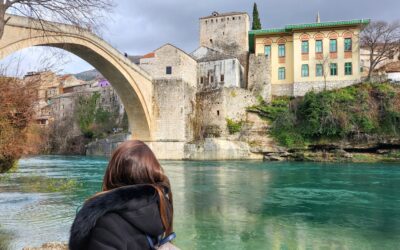
An Ottoman stone bridge with nine arches, originally built in 1574 over the Trebišnjica river outside town. In 1965 the river was dammed for hydroelectric power and the bridge was submerged. It was dismantled stone by stone in 1966 and reassembled at its current location upstream from 1970 to 1972 — every stone numbered and put back where it belonged.
The bridge is photogenic, especially in late afternoon light. It’s a 5-minute drive from the old town, free to walk across, and the riverside park around it is good for an evening hour. Some guests prefer this over Hercegovačka Gračanica if they have to pick one of the two on a tight schedule.
Food and wine — what’s actually worth it
Trebinje is a wine and food region. The Hercegovina cuisine is heavier and more meat-focused than the Croatian coast — grilled lamb, čevapi, slow-cooked beef in clay pots, smoked dry-cured meat, and a strong dairy tradition (kajmak, soft cheeses, ajvar).
- Tvrdoš monastery wines. Vranac (red) and Žilavka (white) — both indigenous Hercegovina varieties. The monastery’s own production is reliable; pour at home or buy a bottle to bring back to Dubrovnik.
- Vukoje winery. The largest commercial Trebinje winery, with a tasting room outside town. Solid Žilavka and a serious Vranac. Better-organised tastings than Tvrdoš.
- Restaurants on or near Trg slobode. Restoran Studenac and Vinoteka are the two we send guests to most often — local food, local wine, table on or just off the plane-tree square.
- Hercegovačka kuhinja outside town. Several roadside taverns (kuće) on the way to Tvrdoš serve traditional Hercegovina dishes — slow-roasted lamb under a peka iron lid is the signature. Order ahead for peka, it takes hours.
For guests on a half-day, lunch in town with a glass of Žilavka covers it. For a full day, Tvrdoš tasting in the morning, lunch at a peka tavern, walk in town in the afternoon.
Border crossing — what to know
Brgat Gornji (Croatia) – Ivanica (Bosnia) is a category-2 international crossing. It’s open in daylight hours — typically 06:00 to 22:00, sometimes longer in summer — and handles passenger cars and small commercial traffic only. No buses, no trucks.
- Documents: A passport is the safe option for all travellers. Some EU citizens may use a national ID card, but non-EU visitors should carry a passport and check current entry rules.
- Vehicle papers: Original car registration and proof of insurance. For rental cars, the rental company must permit cross-border travel into Bosnia (most do, sometimes for a fee).
- Insurance: Croatia’s Green Card insurance usually covers Bosnia, but check the rental papers. Our private transfer vehicles all carry the necessary cross-border coverage.
- Wait time: Usually quick — often under 15 minutes outside peak summer weekends. Brgat is generally the fastest cross-border option from Dubrovnik, but waits can extend on busy summer days or around local events.
The return drive is the same border in reverse. Croatia is in Schengen, so the entry check on the way back is more thorough than the Bosnian exit, but still quick at this small crossing.
Combining Trebinje with other day trips
Trebinje pairs well with several other half-days from Dubrovnik:
- Trebinje + Konavle wineries. Drive back via Konavle on the Croatian side — both wine regions in one day, two short borders.
- Trebinje + Cavtat. The drive back from Trebinje passes within 10 minutes of Cavtat. Easy combination if guests want to tick both off.
- Trebinje as the return leg from Bay of Kotor. Some of our longer Montenegro day trips return through Bosnia and Trebinje instead of the same coastal border. The total drive is similar, but the return border is much faster than a peak-summer Karasovići queue. see our Montenegro from Dubrovnik guide.
When to visit Trebinje
Trebinje is a year-round destination but it shows differently by season. The summers here are hotter than on the coast — inland Hercegovina gets 35°C+ regularly in July and August, with no sea breeze. The plane trees on the main square handle that, but Tvrdoš and the bridge are exposed.
- April–June: Best months. Wildflowers in the surrounding hills, mild temperatures, the Trebišnjica river full and green.
- July–August: Hot. Start early, finish lunch by 14:00, take the afternoon café-on-the-square approach.
- September–October: Wine harvest. Tvrdoš and Vukoje both run during the harvest season — the cellars are working, the timing is perfect for tastings.
- November–March: Quieter, cooler, restaurants and monastery still open. Good for guests who want a working town rather than a tourist version.
How we set up Trebinje from Dubrovnik
The standard Trebinje run we book is half-day: pickup in Dubrovnik around 9:30, border by 10:15, monastery and Hercegovačka Gračanica before lunch, lunch in town on the plane-tree square, afternoon walk and the bridge, back in Dubrovnik by 17:00. Add a wine tasting and it becomes a full day.
For guests staying near the airport or in Cavtat, a Trebinje half-day works well as a pre-flight day — drive to Trebinje in the morning, lunch, return to the airport for an evening flight. We do this regularly when guests want to fit one more thing into their last day.
If you’d like us to handle the Trebinje run, send your dates and which combination interests you — half-day with old town and one of the monasteries, full day with wine tasting, or a combination with Konavle, Cavtat, or as a Bay of Kotor return leg. Dubrovnik to Trebinje private transfer | Private tours from Dubrovnik
Frequently asked questions
How far is Trebinje from Dubrovnik?
Trebinje is 30 km from Dubrovnik old town via the Brgat Gornji border crossing. The drive takes 40–50 minutes including the border, which is one of the smallest and fastest crossings in the region.
Do I need a passport to go to Trebinje from Dubrovnik?
For most foreign visitors, yes — Bosnia and Herzegovina is not in the EU or Schengen, so the Croatia–Bosnia border at Brgat is a full international crossing. Some EU citizens may be able to enter with a national ID card, but non-EU travellers should carry a passport and check current entry rules before travelling. A driving licence is not a substitute.
Is Trebinje worth visiting from Dubrovnik?
Yes — it’s the easiest cross-border day trip out of Dubrovnik. Short drive, usually quick border, working Orthodox monastery with a winery, hilltop church with a wide valley view, and an old Ottoman bridge that was dismantled and reassembled stone by stone. Half-day is enough; a full day with lunch and wine tasting works just as well.
Which border crossing do you use for Trebinje?
Brgat Gornji (Croatia) – Ivanica (Bosnia and Herzegovina). It’s a small daylight-hours crossing for passenger cars only — no buses or trucks — typically open from 06:00 to 22:00. Wait times are usually short outside peak summer weekends, which is the main practical reason Trebinje works so well as a day trip.
Can you visit Tvrdoš monastery from Dubrovnik?
Yes. Tvrdoš is 5 km outside Trebinje and is a regular stop on our Trebinje day trips. The monastery is open to visitors during daylight hours, and the cellar runs informal wine tastings of Vranac and Žilavka. Booking ahead is recommended for groups.
What currency is used in Trebinje?
The Convertible Mark (BAM) is the official currency in Bosnia and Herzegovina. In Trebinje, euros are accepted in many tourist-facing restaurants and shops, often at a 1 EUR ≈ 2 BAM rate, but acceptance varies and some smaller spots are BAM-only. Card payments work in most restaurants and the larger shops.
How long should I spend in Trebinje?
For a focused visit covering the old town, plane-tree square, Tvrdoš monastery and Hercegovačka Gračanica, 4–5 hours on the ground is enough. Adding lunch and a wine tasting makes it a 6–7 hour day. Trebinje is small, so longer than that and visitors usually start to repeat the same streets.