Most visitors treat Dubrovnik as a coastal stop and nothing more. Then they look at a map and realise Bosnia and Herzegovina starts about half an hour inland. As a limo service from Dubrovnik, we take travellers across that border most weeks from spring through autumn, so this is the practical version of how the trip works, what each town actually offers, and where it makes sense to use us versus a local driver once you are over there.
The four places we get asked about from Dubrovnik are Mostar, Sarajevo, Međugorje, and Trebinje. Each one is a different kind of day out of the city. Below is what we tell guests in the car before we leave Dubrovnik.
Why Bosnia is closer than it looks
Bosnia sits right behind the mountains that rise up from the Dubrovnik coast. You do not need a flight, an overnight, or a complicated plan. A morning start gets you to a different country, a different currency, and a different alphabet before lunch.
It is worth saying that Bosnia is one of two countries you can reach this easily from the city. Plenty of the people we drive do both on the same trip, pairing a day in Hercegovina with one of the most rewarding spots in Montenegro within reach of Dubrovnik. This guide stays on the Bosnian side of that choice.
The crossings work in your favour too. Since the Pelješac Bridge opened in 2022, the drive no longer needs the old Neum corridor, so you skip the extra Croatia–Bosnia–Croatia formalities it used to involve. You now cross only once, when you enter Bosnia for the Mostar road. That single change cut a lot of bureaucracy out of the trip.
Here is how the four destinations compare:
- Trebinje: 30 km, 40–50 minutes. The easy half-day. Brgat–Ivanica crossing.
- Međugorje: about 120 km, roughly 2 hours. Pilgrimage town. Doljani–Metković crossing.
- Mostar: about 135 km, 2.5 hours. The UNESCO bridge town. Doljani–Metković crossing.
- Sarajevo: 230–260 km, 4–4.5 hours. The capital. Best as an overnight, not a day trip.
One thing worth saying plainly: distances in Bosnia are short on the map but slow on the road. Mountain stretches, two-lane roads, and border queues in July and August all add time. We plan around that.
Mostar: the one bridge worth crossing a border for
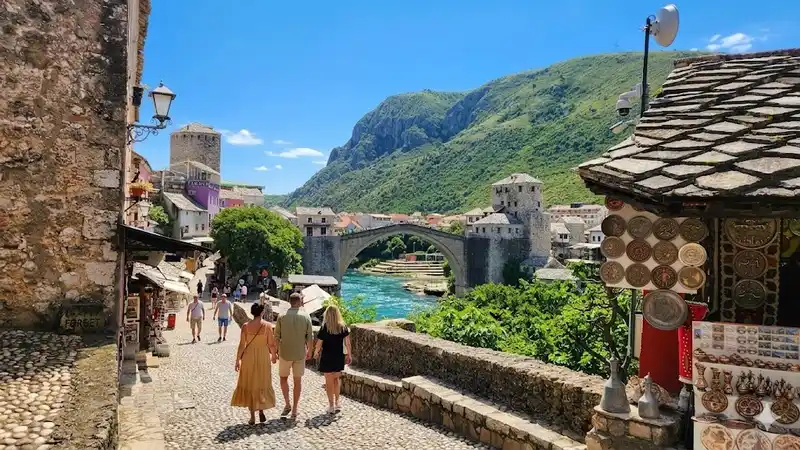
Mostar is the most-requested trip we run out of Dubrovnik, and once you stand on the bridge it is obvious why. In a couple of hours you go from a polished Croatian coast town to a 16th-century Ottoman river town with a completely different feel.
The drive from Dubrovnik is about 135 km and takes roughly 2.5 hours each way before stops. We follow the coast to the Pelješac Bridge, then turn inland through the Neretva valley to the Doljani–Metković crossing. It is one border, usually well-staffed on the Bosnian side. The predictable slow window is Friday afternoon, when weekend traffic builds in both directions. It is the trip we book most often, and the transfer from Dubrovnik to Mostar runs door to door, with the vehicle paperwork ready for the crossing.
Stari Most: what actually happened to it
The Old Bridge (Stari Most) is what draws the crowds. The original was built between 1557 and 1566 for Suleiman the Magnificent, designed by Mimar Hayruddin, an apprentice of the great Ottoman architect Sinan. It stood for 427 years.
On 9 November 1993, during the war, it was shelled and collapsed into the Neretva. The rebuild ran from 2001 to 2004 using the same Tenelija limestone from the same quarry and old Ottoman techniques. Divers recovered original stones from the riverbed, though many were too damaged by the shelling and the water to reuse. It reopened on 23 July 2004 and UNESCO listed the Old Bridge area in 2005.
The bridge stands about 24 metres above the river. In summer you will see local divers leap from it, a tradition that goes back centuries. They usually collect a small crowd, and tips, before they jump. It is worth waiting a few minutes for.
What else to do in town
The old bazaar (Kujundžiluk) runs right up to the bridge: copper workers, coffee sellers, and a lot of tourist stalls mixed in. It is small. Most people cover the bridge, the bazaar, and a riverside lunch in two to three hours, which is the right amount of time before the day-trip crowds thin out.
- Koski Mehmed-Pasha Mosque: you can climb the minaret for the classic postcard view down onto the bridge.
- Crooked Bridge (Kriva Ćuprija): a smaller Ottoman bridge, a quiet two-minute walk from the main one.
- Food: Hercegovina cooking is heavier than the coast, with ćevapi, grilled meat and burek. Riverside tables near the bridge charge for the view; the streets one block back are cheaper and just as good.
Stops we can make on the way
This is where a private driver earns his keep. The Mostar corridor passes several places that a bus simply drives past, and we can build them into the same day at no real detour:
- Počitelj: a stepped medieval Ottoman village on the Neretva, about 30 minutes south of Mostar. Stone lanes, a hilltop fortress, and the 1563 Hajji Alija mosque. Free to wander, 20–30 minutes is enough.
- Kravica Waterfalls: a wide tufa waterfall about 40 km from Mostar. Entry is usually around 20 BAM (roughly €10), so carry some cash even though card payment is often available. In summer people swim in the pool at the base. Allow an hour with the walk down and back.
- Blagaj Tekija: a 16th-century dervish lodge built into a cliff at the source of the Buna river, about 12 km from Mostar. One of the more striking spots in Hercegovina and an easy add-on.
You can also stop on the Croatian side (Ston and its salt pans sit right by the Pelješac Bridge) without adding much to the clock.
Sarajevo: give it an overnight, not a day
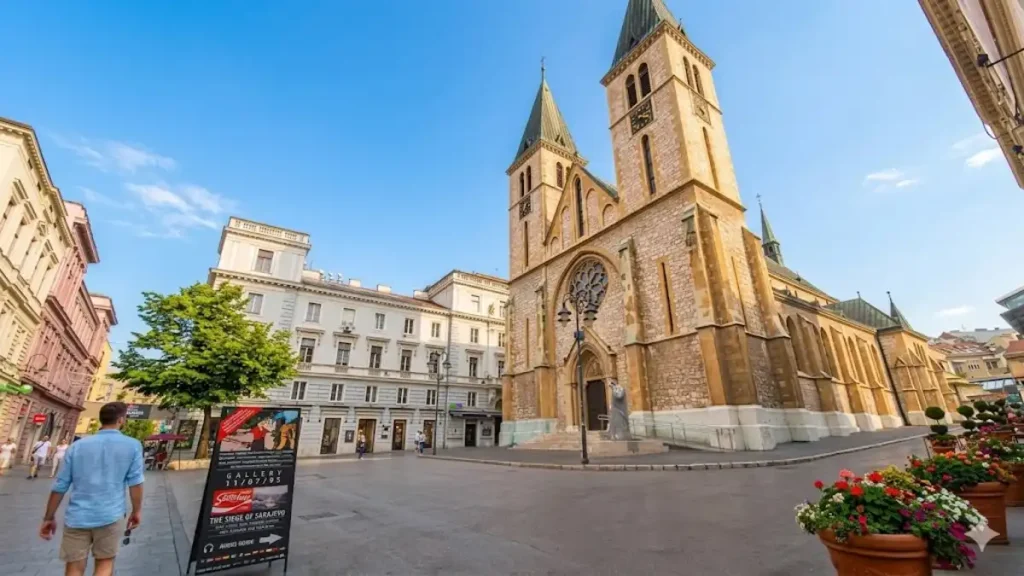
Sarajevo is the one trip from Dubrovnik we will talk people out of doing in a single day. At 230–260 km and 4–4.5 hours each way, a same-day return from Dubrovnik leaves you maybe three hours in the city after eight or nine hours in the car. That is not a fair trade for a capital that deserves more.
There are two ways to drive it. One follows the Neretva canyon through Konjic and Jablanica, on better roads, and you pass Mostar along the way. The other cuts through eastern Hercegovina past Trebinje: shorter on paper but slower because of the mountain sections, with a much quieter border. We usually point first-timers to the Mostar drive, because you can break the journey in Mostar itself.
What Sarajevo gives you
Sarajevo packs Ottoman, Austro-Hungarian, and modern history into a walkable centre, plus a war story you cannot fully grasp from a guidebook.
- Baščaršija: the old Ottoman bazaar and the heart of the city. Start at the Sebilj fountain, walk the copper lane (Kazandžiluk), see the Gazi Husrev-beg Mosque.
- Latin Bridge: where Archduke Franz Ferdinand was assassinated in 1914, the spark for the First World War. There is a small museum on the corner, entry around 4 BAM.
- Tunnel of Hope (Tunel Spasa): the hand-dug tunnel under the airport runway that kept the city supplied during the 1990s siege. It was the longest siege of a capital in modern history. About 20 minutes from the centre, cash only at the gate.
- City Hall (Vijećnica): the striped Austro-Hungarian landmark by the river, burned in the war and since rebuilt.
Two nights covers the main sights without rushing. If you base yourself in Sarajevo, you can also reach Mostar, Konjic, and the Hercegovina towns as day trips from there. We run the Dubrovnik to Sarajevo transfer regularly, and most riders use it as a one-way leg from Dubrovnik to start a Bosnia trip rather than a same-day return.
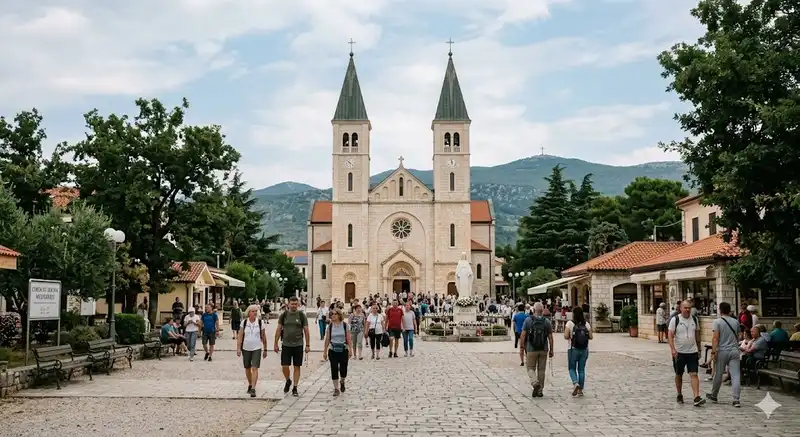
Međugorje: the pilgrimage stop
Međugorje is a specific kind of trip, and the travellers who ask for it usually know exactly why they are going. The town became one of the most visited Catholic pilgrimage sites in the world after six local children reported apparitions of the Virgin Mary on 24 June 1981. Tens of millions of people have visited since.
It is about 120 km from Dubrovnik, roughly 2 hours each way, over the same Doljani–Metković crossing as Mostar. The main sites are close together:
- St. James Church: the centre of parish life, with outdoor services in the season.
- Apparition Hill (Podbrdo): a rocky path up to the spot of the first apparition. Wear proper shoes; it is uneven stone.
- Cross Mountain (Križevac): a steeper climb to a large hilltop cross. For the fit and the dedicated.
Because Međugorje sits so close to Mostar (about 30 minutes apart), the two are often combined in one day. A common shape is Mostar in the morning, Međugorje and Počitelj in the afternoon, back to Dubrovnik for dinner. We can also fold Kravica in if you start early. For pilgrims travelling on their own dates, the Dubrovnik to Međugorje transfer can be one-way or a return with waiting time.
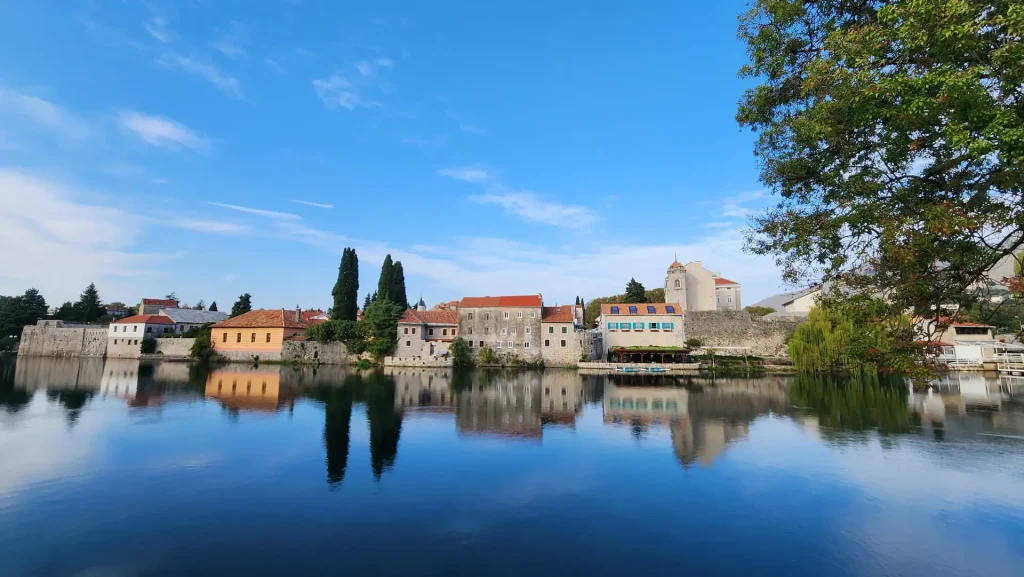
Trebinje: the easy half-day
Trebinje barely counts as a trip in terms of effort. It is 30 km from Dubrovnik over the small Brgat–Ivanica crossing, which is usually quieter than the main Montenegro crossings, and the Dubrovnik to Trebinje transfer takes 40–50 minutes including the border.
It is a small Hercegovina town built around a square shaded by enormous old plane trees, with a working Orthodox monastery and winery (Tvrdoš) nearby, a hilltop church with a wide valley view, and an Ottoman bridge. Most visitors cover it in 4–5 hours, which makes Trebinje the closest Bosnian town to Dubrovnik worth a half-day when you want one simple thing on your last morning before a flight.
Crossing the border: what to bring
Bosnia is not in the EU or Schengen, so every one of these trips is a full international crossing. None of it is complicated, but a few things matter:
- Passport. Carry one. Some EU citizens can use a national ID card, but non-EU visitors should bring a passport and check their own entry rules before travelling. A driving licence is not a substitute.
- Currency. Bosnia uses the Convertible Mark (BAM). Euros are taken in many tourist-facing places, often at roughly 1 EUR to 2 BAM, but smaller spots and entrance gates may want BAM. Cards work in most restaurants.
- Queues. In July and August there are queues at every Croatia–Bosnia crossing. Doljani–Metković is well-staffed but slows on Friday afternoons. Early starts beat the worst of it, and a driver who tracks the borders in real time can adjust on the road.
- Phone data. Croatia is EU roaming; Bosnia is not. Check your plan before you assume your data works across the border.
If you are in one of our vehicles, the car papers and cross-border insurance are our problem, not yours. You just bring the passport.
How we set these trips up
The way we run it is straightforward. We collect you at your hotel or the airport and drive door to door. We guide you through the crossing and keep the vehicle paperwork in order. We stop wherever the day allows (Počitelj, Kravica, Blagaj, Ston) at no real detour. There is no fixed timetable and no set itinerary. It is a vehicle with a driver, shaped around your day.
We also run multi-day trips through Bosnia starting from Dubrovnik, if you want to string Mostar, Sarajevo, and the Hercegovina towns into one longer loop with us driving throughout.
There is a catch worth saying out loud, though. If you are basing yourself in one Bosnian town for a few days, say a few nights in Mostar, keeping our driver and vehicle with you means covering their accommodation too, and that usually is not the smart spend. In that case we would rather connect you with local partners we work with in Bosnia who meet the same standard we hold ourselves to. If you liked how we drive, you will be in good hands with them, and your bill makes more sense.
So the rule of thumb we give guests is simple: day trips and multi-day loops out of Dubrovnik, use us; settling into one Bosnian base for several days, let us hand you to a local partner once you are there.
If you want to put one of these together (a Mostar day, a Mostar-and-Međugorje combination, a Sarajevo overnight, or a longer Bosnia loop), send us your dates and which places interest you and we will map out the timing from Dubrovnik. There are more cross-border ideas worth a look in our Dubrovnik day trips guide.
The full range of what we drive out of the city sits on the private tours from Dubrovnik page, Bosnia included.
Frequently asked questions
Can you do a day trip from Dubrovnik to Bosnia?
Yes, for Trebinje, Međugorje, and Mostar. Trebinje is an easy half-day at 30 km. Mostar and Međugorje are full days at around 2 to 2.5 hours each way, and the two combine well because they sit only 30 minutes apart. Sarajevo is too far for a sensible day trip at 4 to 4.5 hours each way. It is much better as an overnight.
How long does the Dubrovnik to Mostar drive take?
About 2.5 hours each way before stops, covering roughly 135 km. Since the Pelješac Bridge opened in 2022, the drive stays on Croatian territory until you turn inland, so you cross the border only once, at Doljani–Metković, instead of dealing with the old Neum corridor formalities. Border waits can add time in July and August.
Do I need a passport to go from Dubrovnik to Bosnia?
For most foreign visitors, yes. Bosnia and Herzegovina is not in the EU or Schengen, so every crossing from Croatia is a full international border. Some EU citizens may enter on a national ID card, but non-EU travellers should carry a passport and check current entry rules. A driving licence does not work as ID at the border.
What currency do I need in Bosnia?
The Convertible Mark (BAM) is the official currency. Euros are widely accepted in tourist areas, often around 1 EUR to 2 BAM, but bring some BAM for entrance gates, small cafés, and tips. Cards are fine in most restaurants and larger shops.
Can you stop at Kravica, Počitelj, and Blagaj on the way to Mostar?
Yes. All three sit along or just off the Mostar corridor, and we build them into the same day. Počitelj and Blagaj are quick stops; Kravica needs about an hour with the walk and has a gate fee of roughly 20 BAM. We include the stops as part of a private drive with waiting time. It is not a guided tour.
Is it better to use you or a local driver in Bosnia?
For day trips and multi-day loops starting from Dubrovnik, we drive you throughout. If you are staying several days in one Bosnian town, it is usually cheaper to have us connect you with a local partner there rather than cover our driver’s accommodation. The local partners we work with meet the same standard we do. Tell us your plan through the contact page and we will point you the right way.
What is the best time of year for these trips?
April to June and September to October are ideal: mild weather and lighter border queues. July and August are hot inland, with Hercegovina regularly above 35°C and longer waits at the crossings, so we start early. Winter is quiet and the towns stay open, which suits anyone who prefers a working town over a tourist one.